It's a mystery how Peter Schonau Fog manages to combine child abuse, a study of a rural community, affecting tragedy and black comedy into a satisfying whole, but in "The Art of Crying" he pulls it off. A gently offbeat study of a Jutland family in the early 1970s as seen through the merciless, innocent gaze of an 11 year-old boy, this refreshingly unconventional pic tackles its taboos with
compassion, grace and wit.
Jonathan Holland, Variety

Emotionally devastating and astonishingly mature, this is a unique feature debut. Steve Gravestock, Toronto International Filmfestival

A young Scandinavian genius tackles Bergmanesque themes of family taboos and relationships with pathos, humor, and a loving eye. Chiseko Tanaka, Tokyo International Film Festival

Showing posts with label San Sebastian. Show all posts

Saturday, August 11, 2007

"The Art of Crying" in San Sebastian - again!


San Sebastian has 'Cold Fever'
Festival tauts 'New Nordic' section
By EMILIO MAYORGA
(Article from
Variety)

BARCELONA -- Peter Schonau Fog's "The Art of Crying", Pernille Fischer Christensen's "A Soap" and Aleksi Salmenpera's "A Man's Job" are all set to unspool as part of the San Sebastian Festival's "Cold Fever - The New Nordic Cinema" section, announced today


Other films in the sidebar include: Tomas Alfredson's "Four Shades of Brown," Bard Breien's "The Art of Negative Thinking," "Parents" and "Children," both helmed by Ragnar Bragason, and Jens Lien's "The Bothersome Man"


"Cold Fever" aims to explore new trends in contemporary post-Dogma filmmaking Showcase
includes 38 movies from Denmark, Norway, Sweden, Finland, and Iceland, and will be accompanied by a book, written by Danish film critic and writer Christian Monggaard.


"Cold fever" is one of the three sidebars announced by the festival The other two are a tribute to Philippe Garrel and a Henry King retro.


San Sebastian fest runs Sept. 20-29.

Thursday, November 09, 2006

La Ultima Pelicula - review

*****
The Art of Crying... a film to come out the cinema feeling with sonrisilla in the mouth and that strange sensation of happiness well of to have seen a current but special film.


Zabaltegui: The Art of Crying
(Auto-translated by Babelfish)

Kunsten at græde i Kor is the original title of the first film of the young Danish Peter Schonau Fog, winner of the prize of the jury of youth in the festival.

The film counts the story of a peculiar family of a lost town of Denmark from the point of view of a boy, perfectly interpreted by Jannik Lorenzen. His father is an expert in the art to cry, is depressive and every night threatens committing suicide, before which the greater daughter (of about 13 years)"consoles to him" and the mother watches towards another side. Everything goes well until the girl refuses to console her father, which the young person Allan does not include/understand. But, after a death in the town, the father gives a speech by which all admire to him and Allan realizes of which that makes its father happy and tries that there are more funerales at all costs.

The form that has Schornau to treat a as delicate subject as the sexual abuse or the death is admirable. All it does from perspective the intelligent innocent although and perspicaz of a boy of 10 years.

The story makes reir, cry and maintains to the spectator catched and astonished in peculiar personages, an admirable photography and a close story who cause that you leave the room with that sensation of to have been witness of an exceptional but daily history.

The best thing: Allan.
The worse thing: That probably they do not release it in Spain or if they do it he happens unnoticed completely. A pain.

Sunday, October 15, 2006

Reviews in Spanish, French and Euskara(Basque)

(Click icons for reading the original reviews - all texts are auto translated by Babelfish)
In french:


The art of crying of Peter Schonau Fog, Danemarck, Zabaltegi.
Masterly! Already the title: art to cry! Denmark, the Seventies. Still a history of family. Beautiful fair children, an attentive mother, a dairy father, who makes the round while his wife holds the cheese store. Nanan! With through the glasses of Allan, the little boy, we discover little by little as an onion that one peels skin by skin, the secrecies of this family. The father who threatens to commit suicide each night, the mother which throws the sponge, the girl which will calm her father, the big brother who comes and who leaves, the neighbors, customers, the priest, the cemetery and speeches of the dad who make cry everyone. Hard, hard to find itself there without charts, when one loves his father but whom one discovers little by little, which it is not the mast which holds the capital. An interpretation with the razor. Images on glazed paper of this so pretty Denmark, which, it should be said in passing, account the largest rate of suicidesŠ intimate Festen, distilled hand of Master by a realizer who can direct his actors. And an actor who plays the part of the father, parano and pervert with a little more nuances than our Nathalie Baye in My son with me.
In spanish

I LOVE (I CREATE) MY FAMILY

Terrible, desasosegante, the disquieting thing; what anesthesia in dry disturbs but you at the same time she is that in this Danish film everything seems to happen of a natural way, logical, traditional, atavic. As if the form to act of all and each one of their ambivalent, ambiguous and very cabrones personages were recorded in their DNA from the beginning of the times in the south of Jutlandia. The one that the father of Allan wants to commit suicide every five minutes, the one that the mother takes tablets and more tablets to disconnect, the one that Allan thinks that it is normal to make eróticos jueguecitos him to papi to console to him, the one that a doctor anyone, a generalist one immediately, decides the entrance of the sister in a frenopático, is things that are accepted because all suppose (rather, they have learned) that thus have been from always, it is and it will be.
The Art of Crying is of a coldness so that it leaves to the spectator with the generous soul. Of a chosen coldness, assumed and taken to the limit with all its consequences. No, they do not think about Lynch. He is not that. It is not that unhealthy world class. Here EVIL (capital and admiration) it has taken possession from souls and bodies. And those bodies, those souls, ignore that it is thus. The Horrible thing is already meat of its meat.
Addictive and awarded drama, the Volkswagen Prize of the Youth of the own festival of San Sebastián took, that treats a thorny subject as amply it is the child abuse. But this Danish film has osadía to portray to twigs with a certain interest for the somewhat Machiavellian spectators and victimas, incredible performance of the young person Jannik Lorenzen in its paper of the Allan upstart.
The action trascurre in Jutlandia, province of the south of Denmark, at the beginning of the Seventies. The family of the Allan young person is a true disaster. His father often has nervous crises and threatens committing suicide regularly. Her mother has thrown the towel and this in its world, its older brother has gone away of house and the small dairy of the family goes worse of every time. It will depend on Allan to maintain the family united. His father lives only for those moments in that he recites his famous and eloquent ones recited that make cry to all the assistants to a funeral. Soon, Allan will make use to make sure that there are sufficient funerales to maintain his contented father. But little by little it will see that his papa is not the person who he creates and when her older sister lets pass the nights in the sofa with her father, Allan will have to choose between the veneration that feels towards its father or the truth of which it happens between papa and his sister in the salita of house.
Film based on the novel of Erling Jepsen, where it counted his memories of childhood. Rolled to little distance of the places where it in fact happened the action and in dialecto that will cause that in own Denmark it is released subtitled. The director tries to give with a history with a humorous air to enter itself in the beginning in the dark side of the plot. But the force of the film is that there is no bloody nor ill-disposed scene, all this treaty of subtle form, but direct, there is no plane for the controversy. It is an intimist drama but that goes much more there that other films with the same subject, since all the personages overflow a humanity, as much the children as the own father. That causes that we do not feel like discomforts in happening of the action, somewhat non-uniform thing but that certain. As far as the distribution it is necessary to emphasize to Jannik Lorenzen by his paper of Allan and to Julie Kolbeck, like descarriada sister of Allan. They two, next to Jesper Asholt in the paper of afflicted family father, sustained the film with majestic interpretations.
Authentic surprise of the Festival of San Sebastián, this film is used for those incredulous ones that thinks that in Denmark the cinema only exists Dogma and nothing else.
Recently, in this same festival, we have had the opportunity to see the film aid "Mon fils to moi", that also it treated domestic subjects. It did front, showing the problem without adornments, and if it is wanted, without poetry. The film that now I criticize approaches a similar problem but of one more a more implicit way, mainly in the beginning, from the innocent vision of a boy. In my opinion he is superior, by the commented thing and other questions. Pain is one that we have not seen it aid, although at heart little matters.
Humor, black, cruel humor sometimes, flavors east familiar drama, making it thus more interesting and, simultaneously, obtaining a greater impact of its thematic one. With great scenes like the one of the first monólogo of the father in the cemetery, when the boy defies with his glance the person who can threaten her father.
A boy, the actor, who makes a work fantastic, specially for its age. Besides to have a perfect image, with its glasses and their so blond hair, very to tone with the ambientación. And like him, the rest of the actors. The father eats the film. The girl, with her face of going transmits a sensation of incredible resignation.
All this drawn with a fine and elegant photography, alive but nonestridentes colors. Two adjectives, fine and such elegant, can be applied to a direction that promises to obtain new good films that I hope bring to the festival and which they have the same scriptwriter. A counted history of original way but that speech of as old domestic horrors as the family.
With respect to my section, Zabaltegi, to emphasize the good mean level of the projections (far better that the official section to my to understand), in that I found the one who was better film to me from the festival in main lines, the Danish "The art of crying". It is history from the point of view of a small monkey, rubito and innocent of the life of his family, in which his father lacks all security in itself and night wants to force suicide on each (forward edge of dialogue is "in my house, is necessary to be well wide-awake at night because it is when my father is wanted to force suicide on"), the mother is bitter and the sister survives as she can. Sight thus, seems a melodrama to spurt, but nevertheless the film obtains an incredible balance between crude comedy, situations, and beauty of images, mounted with style, dynamism, intensity and a music to frame. When you take to several 4 days sleeping little and seeing pelis the day, and to 12 in the morning you stick 2 hours to the screen, they go flying, and all the room applauds to rage after reir and to cry... is that something has the film. It had raised well them but insuffrable, wishing that they finished. This no. He was agile and entertainment, treating several subjects like pedofilia from innate kindness to the man, as Stone in "World Trade Center" says (only reason why the its boring tear epic is acceptable, kindness and union arisen after badly from the attacks). It is difficult to describe to me I hope much that I liked "The art of Crying", and only to be able to return to see it to see if my enthusiasm is just. Although, to gain the prize of the young jury with as much difference speaking of which it speaks much... has is film that, of to have gone to official, safe, safe section, that it had won (although shared with the Iranian of gold, since there is no another one).
1 The art of Crying 10 Denmark
2 The boss of it all 10 Denmark
3 Babel 9 the USA of Iñárritu
4 Singapore Dreaming 9 Singapur
5 Glue 9 Argentina, produced by Isabel Coixet
6 Sleeping dog´s lie 8 the USA
7 Fair play 8 France
8 Sons 8 Noruega
9 Halfmoon 8 Iran
10- Elle´s bliss 7 Germany
11- Mon fils à moi 7 France
12- Delirious 7 the USA, better script and director to Tom DiCillo
13- Hana 7 Japan de Kore-eda "nobody knows"
14- Zulo 7 Spain
15- Factotum 7 Noruega/Francia/USA..., with the unjustifiable Donostia Matt Dillon doing well of tio hard
16- Children of men 7 USA/España... of Cuarón
17- The Old Garden 7 Korea, of Im Sang soon
18- Backwoods 7 Spain, with Gary Oldman and Aitana Sanchez Gijón
19- Chronicle of a flight 7 Argentina
20- Vete of my 6 Spain, better actor to Juan Diego
21- Prohibited to prohibit 6 Brazil
22- the way of San Diego 6 Argentina, special mention of the jury
23- Cashback 6 England
24- Little miss sunshine 6 the USA, prize of the public in front of Babel
25- ChineseGhosts 5 , inauguration
26- World trade to center 5 the USA
27- Lonely hearts 5 the USA, closing (good Gandolfini, boring script)
28- Children 4 Islandia
29- Copying Beethoven 4 USA/Alemania
30- Chinese One foot off theground 4
31- tail Tiger´s 3 Ireland, John Boorman
32- What I know of Lola 3 Francia/España
33- the lives of Celia 3 Spain
34- They are long! 2 Germany, original music of Mardi Grass
35- the distance 1 España
36- Eves 1 Argentina
37- the family turtle 1 Mexico



(Babelfish can be used to translate spanish and french. Copy the url(http:// ect.) into babelfish and change the language settings. )

Friday, October 06, 2006

Time Out Movie Blog - review

Chris Tilly reports from the influential film festival.

(...) My favourite film of the festival was probably 'The Art of Crying', a Danish coming-of-age tale that follows 11-year-old Allan's efforts to hold his family together in the face of crisis after crisis. A dark (practically pitch black) comedy that owes an obvious debt to Lasse Hallström's marvellous 'My Life as a Dog', the film is anchored by powerhouse performances from Jesper Asholt and Jannik Lorenzen as father and son, and deserves to find an audience outside of Denmark.(...)

(...) 'The Art of Crying' deservedly won the Volkswagen Youth Award for Peter Schønau Fog's subtle, understated direction(...)

Variety - review

The Art of Crying
Kunsten at graede I kor (Denmark)

San Sebastian Posted: Thurs., Oct. 5, 2006, 2:33pm PT

A Final Cut Film Prods. production. (International sales: AB Svensk Filmindustri, Stockholm). Produced by Thomas Stenderup. Directed by Peter Schonau Fog. Screenplay, Bo hr Hansen, based on the novel by Erling Jepsen. With: Jannik Lorenzen, Jesper Asholt, Julie Kolbeck, Hanne Hedelund, Thomas Knuth-Winterfeldt, Gitte Siem Christensen, Rita Angela, Bjarne Henriksen, Sune Thomsen, Tue Frisk Petersen. By JONATHAN HOLLAND


It's a mystery how Peter Schonau Fog manages to combine child abuse, a study of a rural community, affecting tragedy and black comedy into a satisfying whole, but in "The Art of Crying" he pulls it off. A gently offbeat study of a Jutland family in the early 1970s as seen through the merciless, innocent gaze of an 11 year-old boy, this refreshingly unconventional pic tackles its taboos with compassion, grace and wit.

Item plays too many dangerously non-P.C. games to expect universal approval, but "Crying" could bring a smile to the faces of fest auds prepared to take its genre-bending and ethical risk-playing on their own terms.

Pic is divided into six sections, each focusing on a different character. Moustachioed milkman and pathetic monster Papa (Jesper Anholt), continually breaking down in tears and threatening suicide, is married to long-suffering Mama (Hanne Hedelund). They have three kids: bespectacled, blinking Allan (Jannik Lorenzen, terrific), troubled Sanne (Julie Kolbeck), and student Asger (Thomas Knuth-Winterfeldt).

Whenever Papa breaks down in tears at night, it's Sanne's job to go downstairs and console him -- encouraged by Allan, concerned for his father's well-being. On a visit home, Asger discovers what this consolation actually entails, but the emotionally numb Mama is not prepared to admit it.

Knowing that Papa is happiest when delivering over-the-top funeral elegies, Allan prays his father's hated rival, Grocer Budde (Bjarne Henriksen), will die, and Budde's son Nis (Tue Frisk Petersen) is duly killed in a car crash. Allan also indirectly causes the death of Aunt Didde (Gitte Siem Christensen). When Sanne finds a boyfriend, Per (Sune Thomsen), Papa is insanely jealous, and his punishment of Sanne leads her to take terrible revenge.

Years of isolation have meant this community has created its own, bizarre moral rules. The vast, deadening expanses of landscape are effectively portrayed, as are the insular rituals of Jutland life, largely built around repressive Protestantism -- one scene, involving the boy's funeral, ironically has a speech by Papa unlocking the village's emotions in an outpouring of grief.

Pic's bleakness is leavened by lovely observational, surreal humor, mostly generated by using Allan's p.o.v. -- through his innocent eyes, everything that is happening is quite normal. The script controls mood with great precision, expertly negotiating the tragicomic tightrope: tastelessness is never an issue. Perfs are fine, particularly from the blank-faced Lorenzen and vet Asholt, though on a couple of occasions, he allows the excesses of Papa's character to descend into caricature.

On the downside, some scenes are overlong, with unnecessary time devoted to characters such as Aunt Didde who are ultimately marginal.

Camera (color), Harald Paalgard; editor, Anne Osterud; music, Karsten Fundal; art director, Soren Krag Sorensen; sound (Dolby SR Digital), Henry Michaelson, Peter Schultz. Reviewed at San Sebastian Film Festival (Zabaltegi New Directors), Sept. 28, 2006. Running time: 106 MIN.

Quoted in Berlingske Tidende

Tuesday, October 03, 2006

Video from the Award Ceremony


Receiving the Youth Award


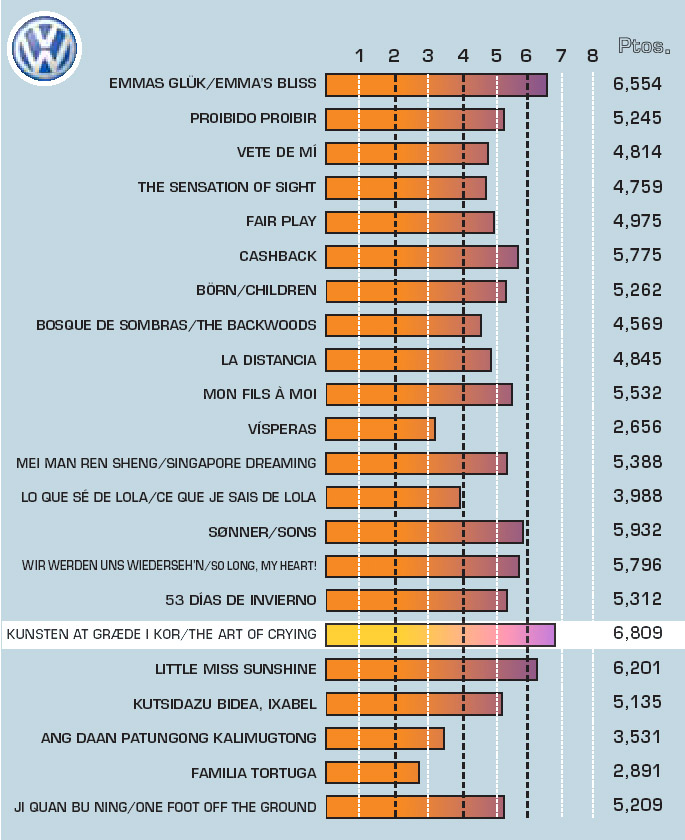
Votes for the Volkswagen Youth Award


Volkswagen Youth Award
The Youth Jury consists of around 350 youngsters from 17-21 years of age, from all over Spain and abroad, collectively selected from schools and film academies, by means of draws or in reply to individual letters of invitation. Participation in the Jury is therefore voluntary and implies the compromise of viewing all of the movies screened in the New Directors selection opting for the Volkswagen Youth Award. Members of the Jury must therefore watch a daily average of three films.

The members of the Youth Jury vote for each film after its screening by means of a piece of paper featuring the different ratings. The result of the votes is announced in the Festival Rag, on its TV channel, and on screens and panels installed at key points such as the Kursaal foyer and the Zabaltegi offices.

It is the Youth Jury members themselves who organize presentation of the award, previously announced to the press at the same time as the Official Awards ceremony. The corresponding plaque is presented at the Youth Closing Gala in the Kursaal Centre prior to screening of the winning title.

Thursday, September 28, 2006

Review in Festival Daily

The Domestic Horror
(Auto-translation by Babelfish)

Although it begins almost with an air of amiable comedy, it is not exempt of certain touches of surrealism and with a narration by a child who momentarily reminds us of the television series Cuéntame cómo pasó, immediately arises all the drama of this film, the abuses, the incest, the deceit. It is indeed a story of abuses without blows, without apparent violence, but buried, the violence of deceit, the emotional blackmail, the constant threat of a suicide that never comes. And there is something strange, because this mixture of the absurd and horror, of comedy and domestic tragedy, creates contradictions in the spectator who does not know whether to hate the paedophile and incestuous father or to feel sorry for a poor man. This is the same dilemma that all of the characters of this remarkable film face, Danish cinema removed from the classic form of the Dogma movement that lately seemed to dominate all Danish cinematography, although in its thematic core it is not distant from the excellent Celebration by Thomas Vinterberg. Nevertheless, in Celebration the adrenalin could be smelled from the beginning, harnessed possibly by the aesthetic principles of the Dogma, whereas here everything goes more slowly. In Vinterberg's film it was difficult to feel compassion for most of his prepotent characters, whereas here it is impossible not to see everyone as losers beyond salvation, losers whose only mistake was to be born in a nuclear family where it was assumed that the pater familias has the right to do as he pleases. And it is this which The Art of Crying - excellent title - brings attention to, another part is the lack of conscience which they have for the victims they are abusing, the absence of protests on the part of a mother who seems not to want to find out what happens in her own home, or even the fatality with which the chavales seem to accept their destiny provided the poor father does not begin to cry and threatens to commit suicide again. The Art of Crying elegantly combines its formal classicism with the courage of the denunciation of practices of patriarcal domination that are not exclusive to Denmark nor to the Seventies. It is a film that somehow camouflages the hardness of the subject by portraying the characters as more amiable, and it would be possible to be debated at length if this approach to the subject helps to disguise the gravity of the facts that it reflects, or, on the contrary, it emphasizes it. M.B.

Festival Daily - interview summary


Festival Daily - interview summary

28/09/2006
ZABALTEGI- NEW DIRECTORS
KUNSTEN AT GRAEDE I KOR / THE ART OF CRYING

Innocence is Not Always Bliss

The young Peter Schønau Fog has presented his first film Kunsten at graede i kor (The Art of crying) based on the successful novel by Erling Jepsen. The script was adapted by Bo Hr. Hansen and according to Schønau they had to make numerous changes while maintaining the focus and emotional content of the book. He points out that the author told him that his film was a faithful reflection of the book when he saw it. It is set in a small village in Denmark in the 1970s and revolves around an eleven-year-old boy who accepts the violent conflictive situation he lives in as being perfectly normal. Despite being a really bleak story, the child’s innocence results in some humorous scenes. In any case, Schønau wants to make clear, “the subject of child abuse is extremely serious for us so it was a real challenge to tackle this subject with appropriate seriousness while enhancing it with a bit of humour”.

Saturday, September 23, 2006

San Sebastian Festival


KUNSTEN AT GRÆDE I KOR/THE ART OF CRYING,
Peter Schønau Fog (Denmark)
The 70s in a small, closed Danish village from which there’s no escape. A dairy farmer discontent with himself and the family he has contributed to forming constantly threatens to commit suicide in his endeavour to earn the love of the kids who console him in rather unorthodox ways. The monsters he has nurtured will leave home and create their own atrocities. A story seen through the eyes of a boy who has his own explanation for his family’s unusual situation. What sets out as a grotesque comedy soon turns into a fable gone terribly wrong.
Screenings:
  • 27. sep. 21:30 Kursaal, 2. Original language with
    Spanish subtitles, English electronic subtitles.
  • 28. sep. 09:30. Principal. Only press and
    accreditation-holders. Priority Press.Original language with Spanish subtitles,
    English electronic subtitles.
  • 28. sep. 12:00. Kursaal, 2. Original language with
    Spanish subtitles, English electronic subtitles.
  • 28. sep. 20:30. Antiguo-Berri, 4.
  • 29. sep. 16:00. Príncipe, 7. Last
    screening.

Thursday, August 17, 2006

Toronto, San Sebastian and Tokyo filmfestivals

The film has been selected for the following festivals:

Toronto International Film Festival:
http://www.e.bell.ca/filmfest/2006/media_centre/news_releaseItem.asp?id=224

THE ART OF CRYING, Peter Schønau Fog, Denmark

World premiere

THE ART OF CRYING follows precocious 11-year-old Allan growing up in a household wrecked by the psychotic behaviour of his milkman father. Desperate to bring peace to his home and prevent a rival family from stealing his father's business, Allan begins to commit appalling acts, blithely unaware of just how atrocious they are.


San Sebastian Film Festival:
http://www.sansebastianfestival.com/2006/in/n005.htm

KUNSTEN AT GRÆDE I KOR/THE ART OF CRYING, Peter Schønau Fog (Denmark)

The 70s in a small, closed Danish village from which there’s no escape. A dairy farmer discontent with himself and the family he has contributed to forming constantly threatens to commit suicide in his endeavour to earn the love of the kids who console him in rather unorthodox ways. The monsters he has nurtured will leave home and create their own atrocities. A story seen through the eyes of a boy who has his own explanation for his family’s unusual situation. What sets out as a grotesque comedy soon turns into a fable gone terribly wrong.

Tokyo International Film Festival:
http://www.tiff-jp.net/pre/2006/en/competition.html


The Art of Crying Kunsten at graede i kor

Here comes a rookie director with formidable talent! A young Scandinavian genius tackles Bergmanesque themes of family taboos and relationships with pathos, humor, and a loving eye.

Director: Peter Schonau Fog

Cast: Jesper Asholt / Hanne Hedelund / Jannik Lorenzen / Julie Kolbech


And is selected for Biografklub Danmark:
http://www.biografklubdanmark.dk/default.asp?path={44F30425-6C0C-4C90-A792-7211701C1CA7}