It's a mystery how Peter Schonau Fog manages to combine child abuse, a study of a rural community, affecting tragedy and black comedy into a satisfying whole, but in "The Art of Crying" he pulls it off. A gently offbeat study of a Jutland family in the early 1970s as seen through the merciless, innocent gaze of an 11 year-old boy, this refreshingly unconventional pic tackles its taboos with
compassion, grace and wit.
Jonathan Holland, Variety

Emotionally devastating and astonishingly mature, this is a unique feature debut. Steve Gravestock, Toronto International Filmfestival

A young Scandinavian genius tackles Bergmanesque themes of family taboos and relationships with pathos, humor, and a loving eye. Chiseko Tanaka, Tokyo International Film Festival

Showing posts with label Mannheim-Heidelberg. Show all posts

Sunday, December 31, 2006

Firpresci at Mannheim-Heidelberg

Fédération Internationale de la Presse Cinématographique
International Federation of Film Critics.

(...) Danish director Peter Schønau Fog also shows a lot of talent. In The Art of Crying he develops another horrifying and strong story. Based on the novel of Erling Jepsen, it shows a family in the south of Jutland in the 70s, whose harmony rests in the possibilities to calm the emotional non-equilibrium of the father, an egotistical and hysterical individual enjoying Schubert's lieder and suffering from crisis of crying with threats of suicide. The only one to calm him is his 14-year-old daughter, whose ingenuous younger brother always convinces her to sleep with the father, although in his innocence the boy doesn't know that what happens between father and daughter is a crime. A terrible and raw secret, also shared by the pusillanimous mother of the children and their older brother, who has left home to study but at his return, sees with impotence how the things at home are still the same.

With a story as this, we would be able to speak of a classical Nordic melodrama, tragic and severe. But the surprising thing is how the director achieves that The Art of Crying stands always on the thin line that divides drama from comedy. He holds a delicate balance that also includes black humor, tenderness and charm. The story is shown from a child's point of view, which is faced to complex situations (not recommendable for someone of this age) and never understands the gravity and sordidness of the situation. Although seeing the way his brothers are acting may tell him that something is not well at all. The plot develops without neglecting its literary origins, but as not many movies dare to do, is divided in chapters, each one dedicated to a character. So the events are made still clearer for the audience, leading to a powerful, captivating and sensitive human portrait in which the performances are fundamental: the two children, Jannik Lorenzen and Julie Kolbech, are true revelations, and as the father Jesper Asholt gives a spectacular performance.


Its formal characteristics – cinematography, music and art direction are excellent — would make this film what is called a "quality film", one that its country selects as candidate for an Academy Award in the best foreign language film’s category. It's true that the narration is traditional and the film has classical visuals, but that does not lessen the emotions of the story, splendidly guided by Schønau Fog, who never uses easy means to move the audience, although it would have been easy doing so, knowing that he had to direct children actors in a incest and abuse story. As Erik Richter Strand in Sons, the filmmaker knows how to create a work with popular leanings, that we can call a genre piece, but it goes a lot further. These are two stimulating debuts from two filmmakers, two new names to follow.


Joel Poblete

© FIPRESCI 2006


Joel Poblete is a journalist and film critic based in Santiago de Chile. He has worked on cultural subjects for Chilean TV, radio and papers and is now a movie critic in the magazine Capital. He is one of the founders and still member of the Chilean critics' publication

Sunday, November 26, 2006

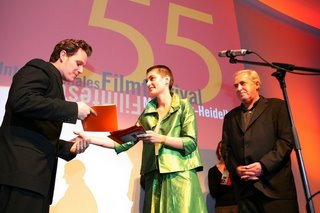
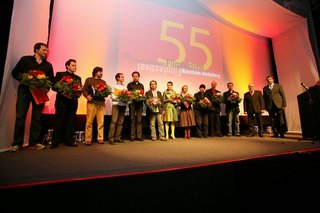
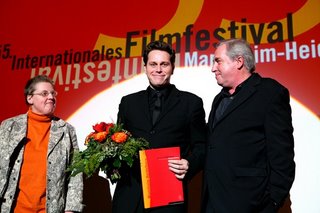
Wins at Mannheim Heidelberg filmfestival

The Art of Crying has won the following prizes at Mannheim Heidelberg filmfestival:

The Audience Award

For the film most liked by the Festival audiense, regardless of genre and length.


Jury's Special Mention for

Jesper Asholt

"For creating an amazing acting achievement for his role of Henry,

in which he succeeds in accomplishing a portrait of a complex,

strong and amusing character"


Recommendations of the Jury of Cinema Owners

First: The Art of Crying

"The film is a tightly directed and sensitive tragicomedy.

Told from little Allan's simple-minded perspective, the film

moves the spectators without leaving a bitter aftertaste behind."


Congratulations to the cast and crew!!

Find more pictures here.


Read about the festival wrap up:

Friday, November 24, 2006

Diderot's Diary - review

Wednesday, November 22, 2006

Kunsten at græde i kor (The Art of Crying)

BASED on the eponymous roman à clef by Erling Jepsen, Kunsten at græde i kor is a tale of abuse and, moreover, the peculiar moral framework families construct for themselves, enabling them to except their own actions from the moral standard to which they hold the outside world. Much to my own surprise, the film is a black comedy, balancing the tragedy of sexual molestation with the absurd humor of adult self-pity and the innocence of youth. This balance is handled with remarkable skill by first-time feature director Peter Schønau Fog and an excellent cast of actors.

Kunsten at græde i kor is set during the 1970s in a village in Jutland near the German border, and 11-year-old Allan (Jannik Lorenzen) is our narrative touchstone. In voice-over Allan eases us into the film by describing how his parents would fight in the evenings, prompting his weak, frustrated father to cry and mope downstairs on the couch, usually punctuating his hysterical sobs with threats of suicide. It's quite unsettling for him to think that Papa (Jesper Anholt) should be so upset, and he waits for Mama (Hanne Hedelund) to relent and temporarily assuage the crying by patching the rift. If Mama has taken one of her sleeping pills, Allan asks his 14-year-old sister, Sanne (Julie Kolbeck) to go downstairs and console Papa.

Allan's naiveté shields him from the madness taking place around him. Even when his older brother Asger (Thomas Knuth-Winterfeldt) visits and warns him not to let Sanne go down to Papa any more, he doesn't understand the reasons why. He sees his Papa as someone to be pleased, not ignored, and Allan takes his constant suicide threats as literally as most children his age. He is aware enough of other families in the village to know that Papa's behavior isn't exactly normal, but, in the unique way that only children can, he accepts it as a fact of life.

Allan proves precociously resourceful when a village boy dies and he accidentally discovers that, like his father, he can manipulate people through tears. Delivering funeral eulogies appears to be the only time Papa comes out of his shell, and the more people cry (encouraged by young Allan's tearful sideshow) the more Papa comes to life. Allan even tries to help Papa's sister, the attention-craving hypochondriac Aunt Didde (Gitte Siem Christensen), into an early grave so Papa will get to enjoy another eulogy. He quite happily and unquestioningly carries out all of Papa's requests, spoken and unspoken, never grasping the seriousness of their consequences. Lorenzen himself must be quite clever to be so capable as a child actor, making his ability to feign straight-faced compliance during some his most appalling acts even more commendable.

As Papa, Anholt cuts a despicable and pathetic figure, an object of pity one moment and utter hatred the next. His underhanded attempts to control the lives of his family through a divide and conquer strategy, all for selfish reasons, are at the center of most of the separate narratives and indeed the film as a whole, though there are more than a few hints that the inclination toward abuse didn't begin with him. What makes this such an unconventional picture of abuse is that Papa rarely resorts to force and violence; he is too feeble for that. All his manipulation is psychological and rests on nothing more than filial loyalty. The trick lies in making his family feel obligated to do what they do not want to. On one or two occasions Anholt does cross the line and slips into caricature during one of his tantrums. These mark the very rare moments when the tragicomic balance is skewed too far in the direction of the latter.

Both the acting and the treatment of such a sensitive subject are first-rate, and the cinematography is equally good. Schønau Fog's domestic interiors have the cozy banality of family homes; the rooms all look and feel like they're lived in, not sets. His exteriors make use use of vivid natural color, with wide, empty landscape shots to show, for instance, how far the bus has to travel to connect this isolated rural village to the rest of the country. Taken together, all these aspects make Kunsten at græde i kor an outstanding film and impressive feature debut.

Read other Mannheim-Heidelberg filmfestival reviews from Diderot's Diary here.

Monday, November 20, 2006

Radio Aktiv - review


Radio review by Heidi Simon:
(in german)


Thursday, November 16, 2006

Mannheim - Heidelberg screenings


The Art of Crying is in the International Competition in Mannheim-Heidelberg. Jannik, Julie and Peter will participate in the festival.


From the festival catalogue:


"Papa is often sad. He cries a lot. Sometimes all night long. Only when his daughter Sanne goes to him, does he somehow calm down. Little brother Alan doesn't understand any of it but he knows how to get Sanne to go to their father. He doesn't understand much of anything that goes on around him actually. Why everything happens at night. Why mother escapes into a knockout sleep using pills. Why daddy always wants to die and eventually never does commit suicide. And why his big sister becomes ever stranger. An eerie look at a scenario of abuse."


A news release from the festival: Fractures in childhood.


Screenings:

Mannheim
Date Time Cinema
November, 19 9.00 pm Atlantis 1
November, 20 11.00 pm Odeon
November, 22 6.00 pm Stadthaus

Heidelberg
Date Time Cinema
November, 18 7.00 pm Gloria
November, 21 10.30 pm Schloss-Kino I
November, 22 10.30 pm Studio Europa